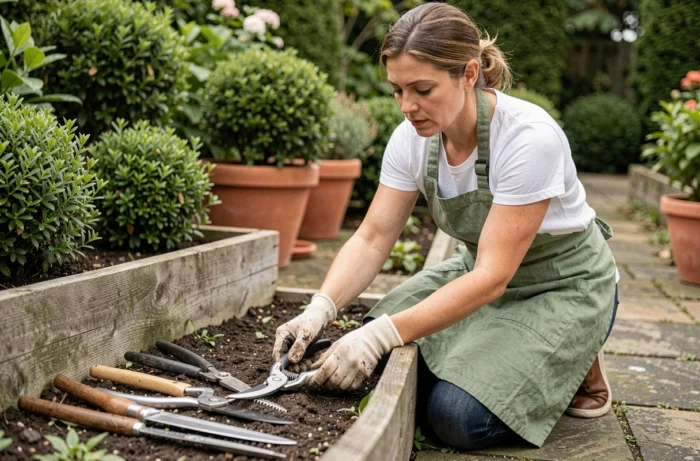
A pruner that crushes stems instead of cutting them cleanly, a lawn mower that wakes up the whole neighborhood, a hose that is too short to reach the back of the flowerbed: these situations resonate with all gardeners. Choosing garden equipment is not just about filling a storage shed.
Each tool, each device must meet a specific use, the configuration of your outdoor spaces, and, recently, a regulatory framework that is tightening regarding noise disturbances.
Noise in the garden: what the law of April 15, 2024 changes for equipment selection
Since the law n° 2024-346 of April 15, 2024, abnormal neighborhood disturbance is codified in the Civil Code (article 1253). Before this text, disputes were based on jurisprudence. Now, a noisy device is more easily exposed to civil liability, even when used during a time slot considered authorized.
In practical terms, a conventional thermal lawn mower or a two-stroke hedge trimmer generates a noise level that can significantly exceed the tolerance threshold of the neighborhood. With this legal evolution, the risk of litigation increases for individuals who do not adapt their equipment.
Why is this point crucial at the time of purchase? Because it directly leads to wired or battery-powered devices, particularly brushless motors, which are quieter than their thermal counterparts. By browsing the equipment offered on Tout pour le Jardin, it is evident that the battery range is taking an increasing place in the catalogs, a sign that the trend is established.
There is still no unique national rule on mowing hours. It is the prefectural and municipal orders that set the authorized time slots, sometimes very restricted on weekends. Checking the order of your municipality before investing in a thermal device prevents ending up with a tool that is unusable during the hours when you actually garden.
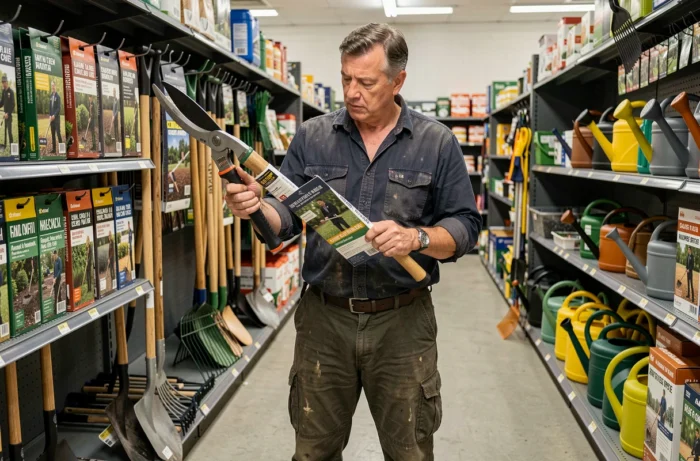
Adapting garden equipment to the area and type of soil
You may have noticed that the same rake does not yield the same results on clay soil and sandy soil? The choice of tools depends as much on the nature of the terrain as on its size.
Small outdoor spaces and terraces
For a balcony, a courtyard, or an urban garden, compact tools are sufficient: hand pruner, trowel, fine-spouted watering can, lawn rake. A common mistake is to oversize. A lightweight hedge trimmer covers the trimming of a few potted shrubs without cluttering a small storage space.
Medium gardens with lawns and flowerbeds
From a significant area, the lawn mower becomes the main investment item. Prefer a model suited to the slope of your land and the type of grass. A battery-powered mower is suitable for most medium-sized gardens and limits noise and engine maintenance constraints.
For maintaining flowerbeds and the vegetable garden, three families of tools cover almost all needs:
- Soil working tools (spade, fork, rake) to aerate, turn, and loosen according to the density of your soil
- Cutting tools (pruner, lopper, shears) whose blade quality determines the cleanliness of the cut and the health of the plants
- Watering tools (expandable hose, timer, drip irrigation) to be sized according to the distance between the outdoor faucet and the farthest area of the garden
Large plots and long hedges
On a large plot, pole hedge trimmers, string trimmers, and sometimes brush cutters become necessary. This is where the choice between thermal and battery-powered weighs the most. Next-generation lithium batteries offer sufficient autonomy for most maintenance sessions, provided you choose an amperage suitable for the expected working duration.
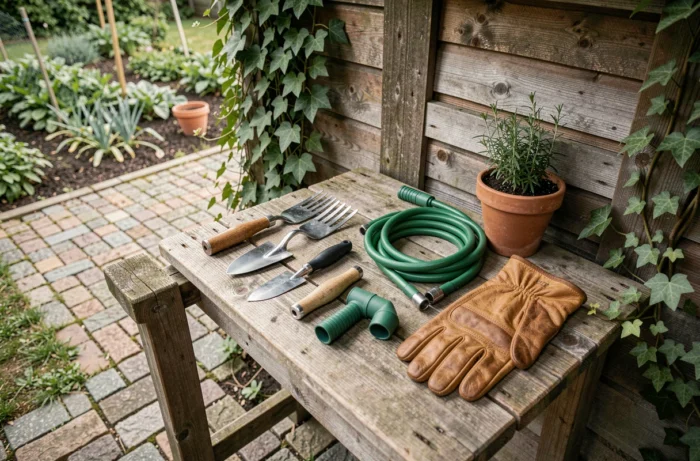
Maintaining garden equipment: a often overlooked selection criterion
Good garden equipment is not only judged at the time of purchase. Its lifespan directly depends on the maintenance it receives. Before choosing a tool, ask yourself: am I willing to dedicate time to its cleaning and sharpening?
Pruner and shear blades lose their sharpness after a few weeks of intensive use. Sharpening cutting tools at least once per season preserves the quality of the cut and avoids injuring the plants, making them more vulnerable to diseases.
For battery-powered devices, winter storage is as important as usage. A lithium-ion battery stored discharged for several months loses capacity irreversibly. The right reflex is to store it at half charge, in a dry and temperate place.
A thermal device, on the other hand, requires regular oil changes, air filter replacements, and winterizing with stabilized fuel. This additional cost in time and consumables must be factored into the purchase decision.
Choosing climbing plants and furniture to beautify the garden
Maintenance is not enough: beautifying your outdoor spaces also involves making coherent choices of plants and arrangements with the available equipment. Climbing plants (jasmine, clematis, honeysuckle) dress a wall or a pergola with moderate maintenance, provided you have a suitable pruner for annual pruning.
Terrace furniture, often considered a decorative purchase, deserves the same practical reflection as tools:
- Aluminum withstands the elements without treatment, but heats up in the sun
- Wood (acacia, teak) ages well as long as it is oiled once a year, which requires having the application equipment
- Wicker resin can be cleaned with a water jet, without specific products, and withstands frost well
Choosing a furniture material compatible with the maintenance you are willing to provide avoids disappointments after two or three seasons.
Arranging a garden cannot be improvised in a single store visit. Starting with basic tools, observing the behavior of the soil and plants over the seasons, and then gradually completing your toolkit remains the most reliable method to avoid accumulating unnecessary equipment at the back of a shed.