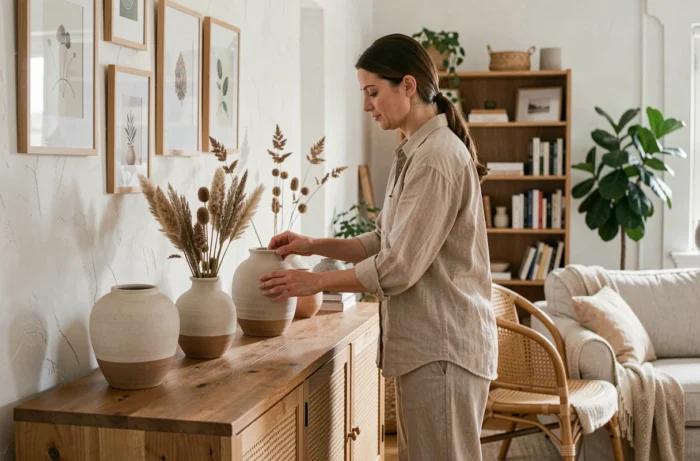
A personalized interior is not built by stacking trends. It relies on precise technical choices, from the color temperature of a light fixture to the proportion ratio between the volumes of a room. We observe that the most accomplished decoration projects start from a spatial or material constraint, not from a generic mood board.
Layered Lighting: The Most Underestimated Customization Lever
Light structures the perception of a space even before the furniture. Poorly thought-out lighting neutralizes any decorative choice, no matter how refined it is. We recommend systematically working in three layers: ambient light, functional light, accent light.
The ambient layer sets the overall level. A single ceiling light creates a flat effect without relief. Opting for indirect sources (LED cornice, diffusing pendant) allows for modulation of the perceived height of the ceiling.
The functional layer targets workstations, reading areas, or kitchen islands. Table lamps or adjustable wall sconces fulfill this role without heavy installation, which is particularly suitable for renters looking for reversible solutions.
The accent layer, on the other hand, creates character. A recessed spotlight directed at an object or a textured wall is enough to anchor the identity of a room. Wireless warm-temperature lamps, which are very present in recent projects, allow for repositioning this accentuation according to the seasons without touching the wiring.
To explore decorative objects and customizable accessories that complement these lighting setups, a useful resource: https://commevousvoulez.fr/.

Proportions and Circulation: Calibrating Decoration to the Geometry of the Room
Decorating without considering the actual dimensions of the room is like dressing blindly. A sofa that is too deep in a narrow living room compresses circulation and makes the space feel oppressive, regardless of its style.
The first rule we apply: leave at least a passage of sufficient width between each piece of furniture. Below that, the flow of movement breaks, and the room appears cluttered, even with few elements.
Relationship Between Ceiling Height and Furniture Volume
A low ceiling calls for lower furniture. Placing a tall bookshelf in a room with low height visually crushes the volume. Conversely, a generous ceiling supports vertical pieces (full-length mirror, column shelf) that exploit the height without wasting floor space.
Contrast of Shapes
Harmony arises from controlled contrast, not repetition. A straight-lined sofa benefits from being paired with a coffee table with rounded edges. This principle of opposing geometries creates a measured visual tension that captures attention without tiring it.
- Straight furniture + curved accessories (vases, oval mirrors): softens a structured interior
- Rounded furniture + rectangular frames or linear shelves: anchors an overly fluid decor
- Organic shapes (raw wood, irregular stone) + industrial lines (metal, concrete): adds depth without overload
Mixing Old and New: Building an Interior with a Story
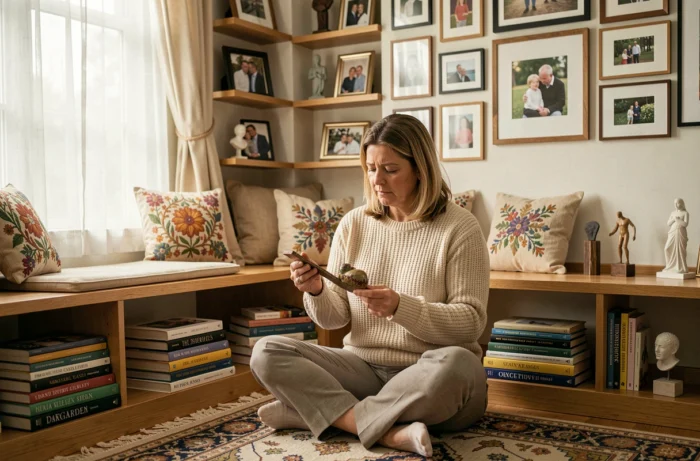
The most personal interiors do not come from a single catalog. The underlying trend in decoration moves away from the “perfect showroom” to favor spaces where patina, thrifted objects, and contemporary pieces coexist. This mix tells a story that new furniture alone cannot convey.
Introducing an antique piece into a contemporary environment requires a point of coherence. This link can be a finish (the brass of an old handle echoed in a modern light fixture), a shade (the dark wood of a vintage sideboard echoed by a current photo frame), or a texture (the linen of a thrifted armchair matched with new curtains).
What to Avoid When Mixing Eras
The classic pitfall is overdoing it. One strong antique piece per room is enough to create a focal point. Beyond that, the space tips into clutter and loses its clarity.
Another common mistake: treating the antique object as a museum piece, isolated from the rest. A 1960s armchair works better flanked by a current table lamp than placed alone in an empty corner. The old must participate in daily use, not serve as a showcase.
Wall Personalization Without Heavy Renovations: Adhesive Panels, Textiles, and Frames
Walls represent the largest visible surface of a room. Leaving them bare means giving up half of the decorative potential. Reversible solutions have significantly refined and now offer a finish comparable to permanent ones.
- Repositionable adhesive panels mimic wood, caning, or stone with a thickness sufficient to create a perceptible relief to the touch
- Wall textiles (tapestry, oversized fabric headboard) absorb sound and add a tactile dimension that paint does not provide
- A composition of photo frames in varied formats aligned on a common horizontal axis structures a wall without freezing it, and is easily renewed
The technical point to remember: on a light wall, grouping frames into a compact block creates more impact than dispersing them. On a dark or textured wall, a more generous spacing allows each piece to breathe.
Decoration that reflects your image is not just about choosing a style from a magazine. It relies on concrete trade-offs between light, proportions, materials, and the history of objects. A personalized interior is recognized by its silent coherence: each element has its place because it responds to a spatial and sensory logic, not to a passing trend.