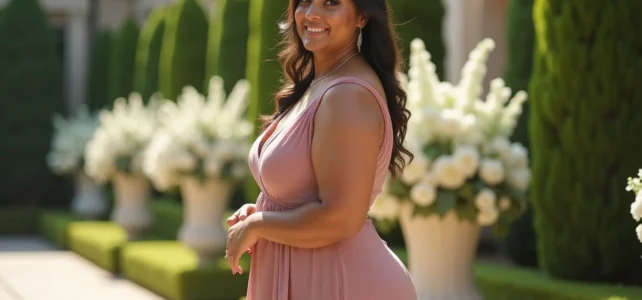
The A-line dress is defined by a fitted cut at the shoulders that gradually flares out to the hem, without marking the waist. This simple geometry, inherited from the 60s, distributes volume evenly across the lower body. For plus-size figures, this distribution of fabric makes a difference during a wedding: it frees the belly and hips from any compression while structuring the silhouette from the top.
Fabric and fit of the A-line dress: what makes the difference in plus sizes
On a standard size, most fabrics work well in an A-line cut. Starting from size 46 or 48, the choice of fabric becomes the primary technical criterion. A fabric that is too light (fine polyester voile, unlined chiffon) will cling to the body’s curves with the slightest movement or gust of wind. A fabric that is too rigid (thick taffeta, heavy mikado) will create a cardboard effect that prevents the dress from falling fluidly.
The right compromise lies in materials with fluid drape and moderate structure: good density crepe, structured stretch jersey, or cotton blended with a bit of elastane. Lace works very well layered over an opaque base, provided that the underlying fabric is dense enough not to deform under the weight of the lace.
Choosing a chic A-line dress for plus-size weddings first involves checking this point: the material must maintain its flared line without assistance, even after several hours of sitting or standing.
Midi length and neckline: the two morphological adjustments to master
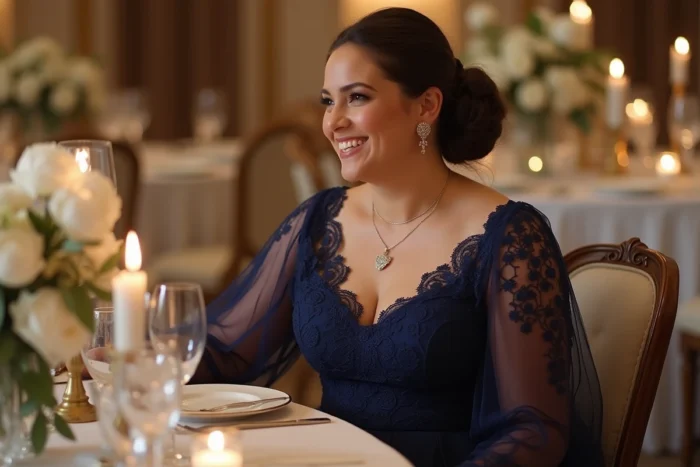
The midi length (below the knee, mid-calf) is the most suitable for a plus-size guest. It elongates the silhouette without the dramatic effect of a floor-length dress, which can shorten an average stature. It also avoids the short dress above the knee, which is often less comfortable when sitting, standing up, or dancing during the reception.
The neckline is the second adjustment. On an A-line cut, it is the top of the dress that visually structures the silhouette, since the bottom is free. Three options work particularly well in plus sizes:
- The V-neckline elongates the bust and visually slims the upper body. The deeper the V, the more pronounced the elongation effect, but a moderate V is still suitable for a wedding.
- The boat neckline horizontally exposes the shoulders, which suits women who want to highlight this area without revealing the bust.
- The classic round neck, often associated with three-quarter sleeves, offers a reassuring and elegant frame for those who prefer to cover their arms.
The question of sleeves is not trivial. Short or three-quarter sleeves in fluid fabric provide comfort without stiffening the A-line silhouette. Sleeveless models work as long as the straps are wide enough to support a suitable bra.
Colors and prints for a wedding: pitfalls to avoid in plus sizes
The basic rule for a guest remains the same regardless of size: no white, no cream, no ivory. In plus sizes, certain prints pose an additional problem. Highly contrasting patterns (large polka dots, wide horizontal stripes, XXL flowers on a light background) tend to visually cut the silhouette into blocks.
Solid colors or discreet prints (small flowers, tone-on-tone patterns) yield a more coherent result on a flared A-line cut. Deep colors (navy blue, burgundy, pine green, plum) remain safe bets for a wedding. Pastel shades also work, provided the fabric is opaque: a powder pink in transparent voile on a light background will lose all its visual structure.
Black is divisive. Technically, it slims and gives structure to the cut. Culturally, it is still perceived as austere for a daytime wedding. For an evening ceremony, a black midi A-line dress is an elegant option that works very well.
Accessories and adjustments: what transforms an A-line dress into wedding attire
The A-line dress, by definition, does not mark the waist. Some women prefer to restore this distinction with a belt. This option works, but only with a soft belt (satin ribbon, thin leather belt) placed just under the bust, in an empire position. A thick belt at the natural waist breaks the A-line and creates a volume effect above and below.
Shoes are just as important as the dress. A block heel of a few centimeters stabilizes posture and elongates the silhouette under a midi dress. Flat sandals work for a rustic wedding, provided the hem of the dress does not drag on the ground.
- Dangling earrings draw attention to the face and complement a V-neckline.
- A small structured bag (hard clutch, minaudière) balances the fluid volume of the dress.
- A lightweight linen or silk shawl protects the shoulders for an outdoor ceremony without adding volume.
The final adjustment concerns the lining and internal finishes. A plus-size A-line dress worn without a lining will cling to tights or skin, especially in hot weather. Checking for the presence of a lining separate from the outer fabric, ideally in viscose or cotton, is part of the selection process not to be overlooked during fitting.
The French textile environmental labeling system, which will gradually become mandatory starting October 1, 2025, will make the ecological impact of dresses visible on their labels. This criterion can guide the choice between two equivalent models, especially for those looking for a dress that can be reused after the wedding rather than a piece worn just once.