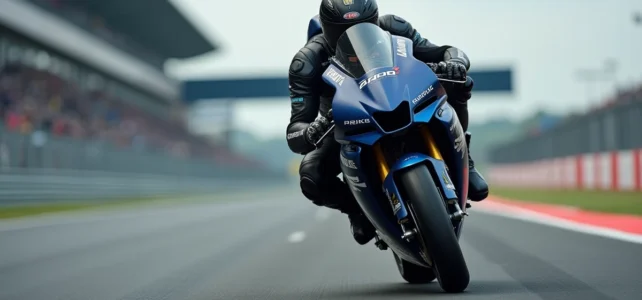
On a winding departmental road or at a toll exit, a motorcycle is not judged in the same way. The raw time on a quarter mile says nothing about the ability to handle corners loaded with luggage, nor about the behavior after three hours in the saddle. Motorcycle performance comparisons gain relevance when they encompass multiple real-world situations, not just the technical specifications.
The current market reflects this logic: the models that stand out are no longer necessarily the most powerful, but those that combine performance, versatility, and onboard electronics.
High-Performance Road Trails: Why They Dominate Motorcycle Comparisons in 2026
Motoplanete reports a rise in the popularity of road trails for the first half of 2026, to the point of talking about a “strange shift in two-wheelers.” We are no longer in the realm of gently comfortable adventure motorcycles. Road trails have become the new benchmarks for usable performance: road bridging, long-distance comfort, advanced electronics.
The BMW R 1300 GS Adventure embodies this trend. In the face of the Triumph Tiger 1200 GT Explorer, the duel is not played out on maximum power. It is played out on the chassis, the electronic suspension management, and the behavior with a passenger and luggage. A quick road test followed by a ride on a narrow secondary road reveals differences that the technical sheet does not hint at.
This logic is also found at Honda with the Africa Twin, whose recent developments aim for versatility rather than an excess of horsepower. To delve into each motorcycle performance duel and comparison, it is essential to compare the models in their real-world usage conditions, not just at full load on a circuit.
Power-to-Weight Ratio and Chassis: What a Four-Cylinder Roadster Duel Reveals
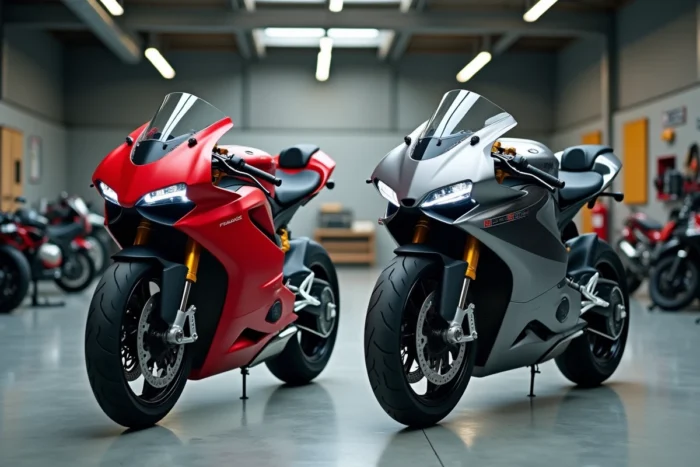
The duel between the Honda CB1000 Hornet SP and the Kawasaki Z900 SE illustrates a often underestimated point: two engines close in displacement can offer radically different sensations. The four-cylinder Honda and that of Kawasaki do not deliver their torque in the same way. During acceleration in third gear between 80 and 130 km/h, the difference is clearly felt.
The chassis plays a role at least as decisive as the engine. A rigid frame with a well-calibrated fork forgives approximate trajectories. A chassis that is too soft gives a feeling of floating in fast corners. In a serious comparison, these behaviors are measured, not just the 0 to 100.
Electronic Suspensions and Riding Modes
The high-end versions (SP, SE, GT+) now integrate semi-active suspensions. The Suzuki GSX-S1000GX against the Yamaha Tracer 9 GT+ shows that onboard electronics change the hierarchy between two motorcycles depending on the selected mode. In sport mode, the Suzuki is more incisive. In touring mode, the Yamaha regains the advantage in comfort.
This parameter complicates fixed rankings. A motorcycle can dominate a duel in one context and lose in another. Feedback on this point varies according to the rider’s profile and the type of route.
Yamaha R9 vs. Kawasaki Ninja ZX-6R: Three-Cylinder or Four-Cylinder Sport
This duel raises a fundamental question about the mid-displacement sport segment. The Yamaha R9, derived from the MT-09, features a three-cylinder engine of 890 cm³. The Kawasaki Ninja ZX-6R remains true to its four-cylinder engine of 636 cm³. On paper, the displacement advantage goes to Yamaha. In practice, the distribution of torque and the high-end pull favor the Kawasaki on the track.
- The Yamaha three-cylinder offers more available torque at mid-range, which facilitates acceleration out of corners on open roads.
- The Kawasaki four-cylinder revs higher with a linearity that reassures during hard braking before a tight corner.
- The ergonomics differ significantly: the R9 has a less radical position than the ZX-6R, which changes the fatigue felt after an hour of intense riding.
The choice depends on the primary playground: fast roads and spirited rides for the R9, track days and pure riding for the ZX-6R.
Small Displacements and Euro5+ Standard: The 125 cm³ Segment Returns to the Race
One year after the implementation of Euro5+, the segment of small 125 cm³ motorcycles and scooters is clearly on the rise in France. Moto-Net mentions a 14.5% increase. This rebound shows that the regulatory transition, which had slowed sales, is now absorbed by manufacturers.
For motorcyclists who ride daily in urban or suburban areas, 125 cm³ offers a performance-maintenance-price ratio that is hard to beat. Their lightness and low consumption make them remarkably effective machines in their context.
Chinese Motorcycles: A Performance Parameter per Euro Spent
The CFMOTO MT Challenge, whose return is confirmed for 2026, illustrates the rise in quality of Chinese manufacturers. These motorcycles no longer aim solely for the lowest price. They offer features (TFT screen, ABS, adjustable suspensions) that were reserved for premium brands a few years ago.
The cost per horsepower criterion becomes relevant in an honest comparison. Comparing only BMW, Honda, and Triumph among themselves ignores a growing part of the market.
Building a Reliable Motorcycle Comparison: The Criteria That Really Matter
Aligning maximum power, dry weight, and price is not enough to differentiate two motorcycles. A useful comparison includes operational criteria that the manufacturer’s sheet does not always mention.
- The weight in running order (full tank, fluids, mounted accessories) gives a more realistic picture than the dry weight displayed by marketing.
- The seat height and the width of the tank at knee level determine accessibility for the majority of body types.
- The maintenance cost over the first kilometers (service intervals, tire prices, brake consumables) weighs heavily in the actual budget.
- The availability of parts and the dealer network influence the downtime in case of mechanical issues.
A BMW trail with a boxer twin engine does not have the same maintenance intervals as a Japanese four-cylinder. This detail changes the total cost of ownership over a few years, well beyond the catalog price difference.
The models that leave a lasting impression are not those that display the highest number on a single line of the technical sheet. They are those that keep their promises on the road, in the city, on the highway, and in adverse weather, mile after mile.