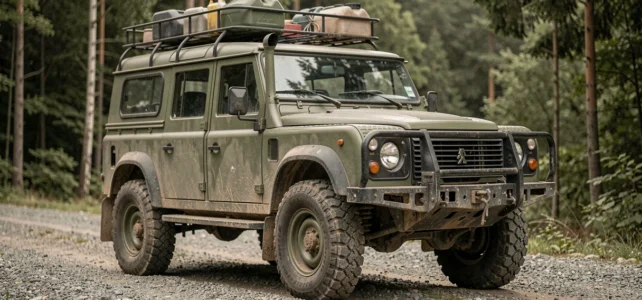
The Peugeot P4, derived from the Mercedes-Benz G-Class and produced for the French army between 1982 and 1995, remains a sought-after 4×4 after decommissioning. Its ladder chassis, rigid axles, and rugged mechanics make it a solid base for modifications. However, any changes to this vehicle impose a dilemma that many owners discover too late: to gain performance or to maintain a favorable administrative status.
Collection status and modifications on Peugeot P4: the arbitration to make first
Before touching the engine or suspension, an administrative question must be settled. The French Federation of Vintage Vehicles (FFVE) considers that any essential modification of the engine, transmission, or chassis may lead to a refusal or withdrawal of the dating certificate. Without this certificate, there is no “collection” mention on the registration document.
Why is this a concrete problem? Because the collection status affects insurance (often much cheaper), vehicle taxation, and, since the expansion of ZFEs, the ability to circulate in certain urban areas. An owner who performs a heavy diesel engine swap potentially loses all of this.
The arbitration thus arises from the start. Light modifications (filtering, exhaust, electrical accessories) generally do not jeopardize the status. Deep transformations (engine change, significant lift, transmission modification) compromise it. Choosing recommended modifications for Peugeot P4 first goes through this regulatory reading grid.
Reprogramming and diesel engine optimization of the P4
The military P4 was equipped with a naturally aspirated XD3 diesel engine from Peugeot, known for its longevity but not for its performance. The original power remains modest, and the torque, although present at low revs, shows its limits as soon as the terrain demands reserve.
Stage 1 reprogramming: the most interesting effort/result ratio
Stage 1 reprogramming involves modifying the engine control unit’s mapping without replacing any mechanical parts. On a diesel, this optimizes injection, boost pressure (when it exists), and torque curves. The gain is mainly felt in smoothness and responsiveness, more than in top speed.
This intervention remains the most financially accessible. It does not modify any visible parts and does not change the characteristics listed on the registration document. For P4s equipped with a turbo (later versions or already swapped), the gain is significantly more noticeable.
Filtering and exhaust: the basic mechanical modifications
Replacing the original air filter with a high-flow model improves engine filling. On the exhaust side, a less restrictive manifold and a freer exhaust line reduce back pressure. These two combined modifications allow the engine to breathe better without compromising its reliability.
- A washable and reusable sport air filter replaces the original paper filter, which limits flow beyond a certain RPM
- A larger diameter exhaust line reduces back pressure and frees up a few horsepower, especially on turbo versions
- Replacing the intake hoses with reinforced silicone hoses improves sealing and thermal resistance
These three modifications do not jeopardize the collection status and form the foundation of any reasonable preparation.
Suspension lift on P4: the 5 cm limit to know
The original P4 already offers a decent ground clearance thanks to its rigid axles and coil springs. For off-roading, many owners wish to go further with a lift.
Have you noticed that the most modified P4s sport suspensions raised by ten centimeters or more? This choice has direct consequences on homologation. Lifts of more than 5 cm require an individual approval (RTI) from the DREAL to remain legal on the road. Below this threshold, the use of approved kits remains tolerated.
Homemade kits, even if well made, pose a problem in case of technical inspection or accident. They are not legally defensible. It is better to turn to lift kits designed for 4x4s with rigid axles, with technical documentation and a certificate of conformity.
What the lift changes in behavior
Lifting a P4 changes its center of gravity. The vehicle gains off-road capability (better approach angle, more travel) but loses stability on the road, especially in high-speed corners. A shock absorber adapted to the new height is mandatory, not optional. Installing longer springs without changing the shock absorbers accelerates their wear and degrades road holding.
Transmission and tires: two often underestimated areas
The transmission of the P4 is robust by design, inherited from the Mercedes G-Class. The axles, transfer case, and drive shafts withstand significant stresses. However, as soon as the tire size or engine power is modified, the entire drivetrain experiences additional stresses.
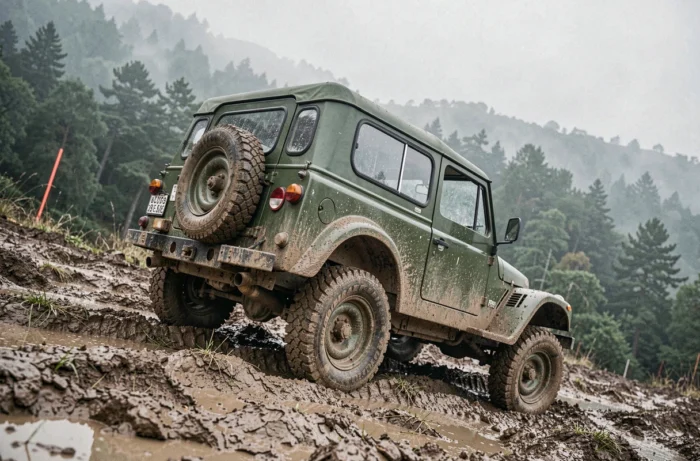
Switching to wider or taller tires increases the resistance torque on the half-shafts and universal joints. Without reinforcement, the universal joints become the weak link. Checking their condition and switching to reinforced universal joints is a logical precaution before fitting aggressive off-road tires.
- Larger tires change the effective axle ratio: the engine runs slower at the same speed, which reduces acceleration
- A change in axle ratio (shorter) compensates for this loss but requires heavy and costly disassembly
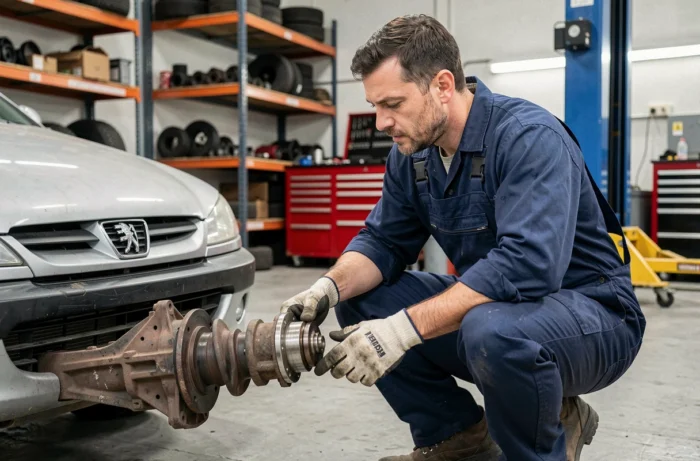
- The hub flanges and bearings should be inspected if the vehicle has already had high military mileage
Adapting tires without touching the transmission means putting the drivetrain beyond its limits. Both areas must be considered together.
The decommissioned Peugeot P4 offers a mechanical base that is hard to fault. The most cost-effective modifications remain those that respect the original balance: measured reprogramming, improved filtering, contained lift below the regulatory threshold, tires consistent with the transmission. Each intervention beyond these thresholds incurs an administrative and technical cost that often exceeds the initially planned budget.