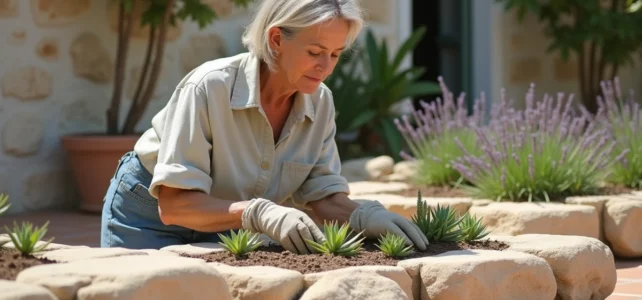
On a a south-facing slope where nothing grows properly, you often end up with bare soil that crusts over in summer and runs off during the first autumn rains. This is precisely the ideal ground for a Mediterranean rock garden. This type of landscaping transforms an ungrateful soil into a vibrant space, structured by stones and colonized by plants that thrive without watering once well established.
Drainage and substrate: the foundation that the Mediterranean rock garden cannot forgive
The first mistake observed in failed rock gardens is soil that retains water. Mediterranean plants tolerate drought, not stagnant moisture around their roots. Before laying any stones, you must ensure that the soil drains water quickly.
On clayey ground, you need to excavate about thirty centimeters and replace part of the soil with a mix of coarse gravel and sand. The goal is to achieve a substrate where water passes through in a few minutes, not hours. If the land is naturally sloped, drainage happens almost by itself, provided you don’t compact the soil with heavy machinery during the work.
The planting mix that works in a dry rock garden: about one-third garden soil, one-third gravel or pumice, one-third coarse sand. A poor, draining soil encourages deep rooting, making the plants more resilient to subsequent heatwaves. You may also want to create a Mediterranean garden rockery on flat ground by slightly raising the bed with a supply of stones and draining substrate.
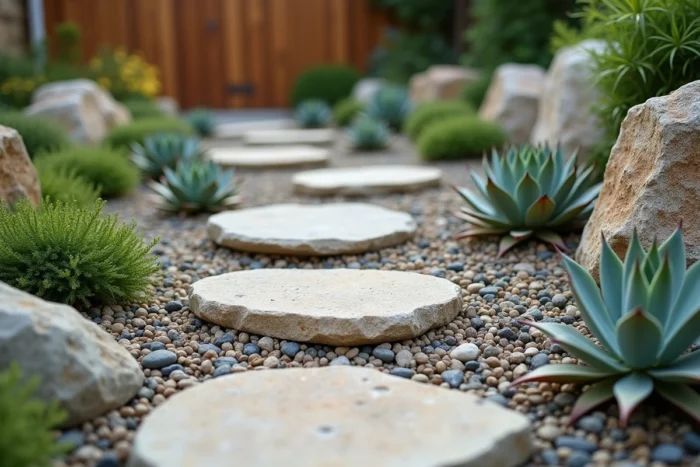
Stone arrangement: three well-placed blocks are better than twenty scattered pebbles
We’ve all seen those rock gardens that look like a pile of rubble dumped in a corner of the garden. The problem almost always comes from the size and placement of the stones. Three large blocks of different sizes create a natural effect that no heap of small pebbles can replicate.
The basic principle: each stone should be buried a good third in the ground. A stone placed on the surface looks artificial and ends up moving. When buried, it gives the impression of naturally emerging, like a rock coming out of a slope.
Choose local stones
Using stones from the region immediately gives a cohesive look. In Provence, limestone is used. In Brittany, granite or schist will make just as convincing a rock garden, provided you select plants suited to the soil’s pH. Feedback on this point varies by region, but a local rock will always be visually more integrated than an imported stone.
Arrange the blocks in a staggered pattern, never in a straight line. The idea is to create planting pockets between the stones, micro-niches where the soil stays cool longer thanks to the shade cast by the rocks. Each gap between two stones becomes a planting spot protected from wind and direct evaporation.
Plants for Mediterranean rock gardens: focus on resilience rather than continuous blooming
Classic content on rock gardens tends to push for a garden that is always in bloom. In a true Mediterranean climate, a rock garden goes through summer rest phases where some plants go dormant. This is normal and even desirable.
Plants that truly thrive without watering after two years of establishment share common characteristics:
- Evergreen foliage, often gray-silver or aromatic (lavender, santolina, creeping rosemary), which limits evaporation thanks to waxy or fuzzy leaves
- Deep or spreading root systems that seek moisture below (thyme, helichrysum, Corsican spurge)
- Succulents and fleshy plants (sedum, houseleek, delosperma) that store water in their tissues and withstand full sun on hot stones
- Compact grasses (blue fescue, stipa tenuissima) that add movement and texture contrast without requiring maintenance
Plant between mid-March and mid-April when the soil exceeds 10 °C, according to recommendations from the Société Nationale d’Horticulture de France. A window until the end of June remains possible by planting later in the day in a very draining substrate.
Mineral mulch and maintenance: the rock garden that almost takes care of itself
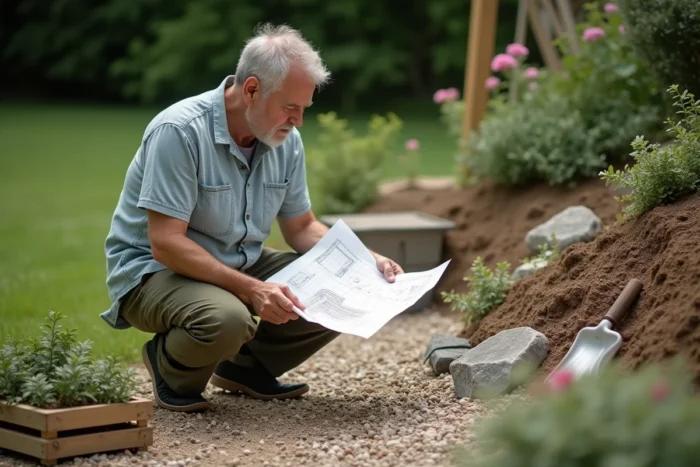
Organic mulching (bark, straw) has no place in a Mediterranean rock garden. It retains moisture at the base of the plants and promotes rot. Instead, use mineral mulch of gravel, pumice, or stone chips with a thickness of a few centimeters.
This mineral mulch serves three functions: it limits the growth of weeds, it returns the heat accumulated during the day to the roots in the evening, and it gives the whole area a natural Mediterranean soil appearance. Choose a grain size and color close to the main stones to maintain visual coherence.
Initial watering then autonomy
In the first two years after planting, water the plants that show signs of stress occasionally. After this establishment period, a well-designed rock garden functions almost without watering, making it particularly relevant in regions increasingly subject to summer water restrictions.
Regular maintenance is limited to light pruning of aromatic plants after flowering and the removal of dry parts at the end of winter. Avoid fertilizing: rich soil produces fast-growing plants that are less resistant to drought and frost.
The Mediterranean rock garden remains one of the most suitable designs for hot summers and difficult soils. Well-drained, planted at the right time, mulched with minerals, it gains density and character each year without requiring constant attention.