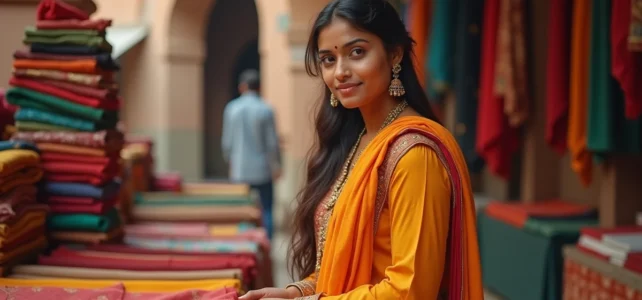
In India, the color of a garment is never neutral. Each shade carries a symbolic weight related to religious practices, castes, funeral rites, or political affiliations. Traveling in India without mastering this color code exposes one to misunderstandings that mere politeness cannot dispel.
White and black in Indian funeral context: two risky colors
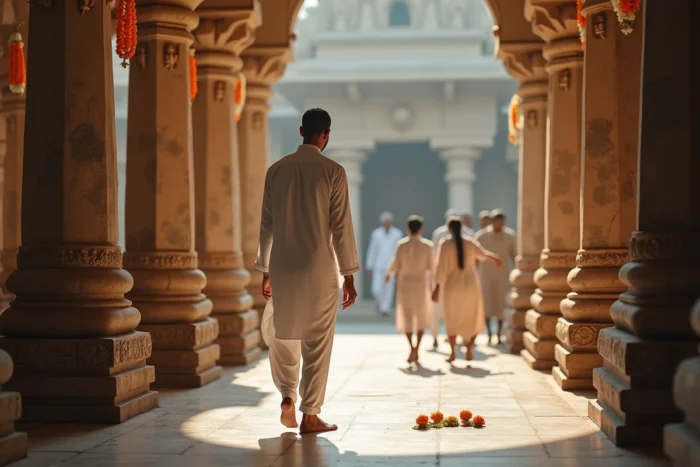
White is the color of mourning in Hinduism. Widows traditionally wear white, and this shade dominates cremations, post-death purification rituals, and periods of family mourning. Wearing white at a wedding, a religious festival, or a birth ceremony inadvertently signals a connection to mourning.
We observe that confusion often arises from a Western reflex: white symbolizes purity, celebration, and civil marriage there. In India, it is the opposite. A traveler in a pristine white shirt at a family puja to which he is invited creates a silent discomfort that his hosts will not verbalize.
Black poses a different problem. It is not associated with mourning as it is in Europe, but it is considered inauspicious in many Hindu contexts. Entering a temple wearing entirely black clothing may be perceived as disrespectful, or even result in being denied access in certain places of worship in Kerala or Tamil Nadu.
To better understand the colors to avoid wearing in India, it is necessary to distinguish between what is a religious taboo and what is a regional social convention.
Saffron and orange in India: religious charge and political dimension
Saffron is the most loaded color of the subcontinent. In Hinduism, it represents renunciation, spiritual quest, and sacred fire. Sadhus and Jain monks wear it as a uniform of ascetic life. Wearing saffron without a connection to spiritual practice can be misinterpreted, especially in ashrams or ghats in Varanasi.
The political dimension complicates the interpretation further. Saffron is also the color of the BJP and Hindu nationalism. In certain institutional contexts or during interfaith gatherings, wearing this shade sends an unintentional partisan signal. We recommend avoiding solid saffron in urban areas of northern India, where political polarization remains strong.
Bright orange and deep saffron: nuance matters
A fluorescent orange hiking t-shirt will not be confused with a saffron dhoti. Misunderstanding occurs when the shade approaches kesari (deep saffron leaning towards red-orange), a specific color of monastic orders. The looser and more uniform the garment, the greater the resemblance to a religious outfit.
Regional variations of color codes while traveling in India
India does not have a uniform national color code. Practices change between cities, rural areas, and religious spaces. The same green will be perceived positively in a mosque in Rajasthan and will go completely unnoticed in a shopping mall in Bangalore.
- In Kerala, white is worn daily by men (white mundu), which mitigates the funeral taboo for men’s attire, but not for women visiting a temple.
- In Punjab, bright colors (red, pink, yellow) dominate Sikh celebrations, and navy blue is associated with the Khalsa. Wearing blue in a gurdwara is not prohibited, but it may be perceived as an identity statement.
- In predominantly Muslim regions (Hyderabad, certain areas of Kashmir), green is respected as the sacred color of Islam. Wearing it is not a faux pas, but associating it with religious motifs without being affiliated can be surprising.
- In cosmopolitan urban areas (Mumbai, South Delhi, Pune), traditional color codes are significantly relaxed, and most shades pass without comment.
Colors to favor for a traveler in India
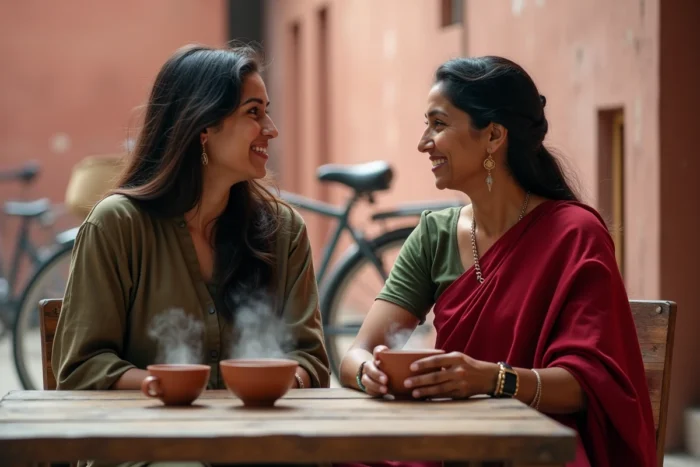
The workaround is simple: warm and moderately saturated shades work everywhere. Beige, sky blue, olive green, and subtle burgundy carry no strong symbolic weight. During ceremonies or temple visits, bright colors like red or yellow are generally welcome, as they are associated with prosperity and joy.
Red, the color of marriage and fertility in Hinduism, is always well-received on a woman invited to a celebration. Yellow, associated with Vishnu and turmeric (haldi), carries a positive connotation in almost all regions.
Temple attire: non-negotiable rules
Beyond color, modesty of clothing is paramount. Shoulders covered, knees hidden, no visible leather (especially in Jain temples). Some temples in the south require men to remove their tops to enter, making the question of color secondary in this specific case.
- Bring a neutral-colored shawl or stole (beige, pastel blue) to cover shoulders at the entrance of a place of worship.
- Avoid prints depicting deities or religious symbols on clothing, regardless of color.
- Always remove leather shoes before entering a Jain temple, and prefer synthetic sandals.
The most common pitfall for a traveler in India is not wearing a strictly prohibited color. It is the contrast between the outfit and the context that creates discomfort: an all-black look at a Hindu wedding, bright white during a family Diwali, solid saffron in a politically tense neighborhood. Adapting one’s wardrobe to each stage of the journey remains the most effective precaution.