The dashboard of the Iveco Daily features several dozen pictograms, with a strict color-coded priority logic. A red warning light requires the vehicle to stop, an orange light allows the journey to continue to the next workshop, and a green or blue light simply indicates the activation of a function. Mastering this hierarchy helps avoid unnecessary breakdowns as well as engine damage.
Multiplexing Logic and Alert Levels on the Daily
On the current generations of the Daily, the instrument cluster receives its information via the CAN network. Each control unit (engine, ABS/ESP, automated gearbox, post-treatment system) sends a fault code that triggers the display of the corresponding pictogram. The same warning light can reflect several distinct fault codes, making OBD reading essential to discriminate the actual fault.
Level 1 (flashing red) sometimes cuts off the boost or limits torque via degraded mode. Level 2 (steady orange) leaves engine management intact but logs a fault in memory. Level 3 (flashing orange) generally indicates an active regeneration of the particulate filter or a scheduled maintenance reminder.
We recommend always checking, when turning on the ignition, that all warning lights briefly illuminate and then turn off. A light that remains off during the initial check indicates a burnt-out bulb or a CAN line fault, both situations that mask a future alert. To delve deeper into the meaning of each pictogram, the resource dedicated to the Iveco Daily dashboard warning lights details the cases model by model.
Engine and Oil Circuit Warning Lights on Iveco Daily
The oil pressure warning light (red oil can) remains the most critical. On the Daily equipped with the F1C 3.0 as well as the F1A 2.3, a drop in pressure below the threshold triggers the alert before the engine suffers a seizure. A common mistake is to confuse this light with the oil level warning light (oil can with a wave), which simply indicates that an oil top-up is needed.
The MIL (check engine) orange light does not always indicate a serious engine failure. On the Daily, it also lights up for a faulty intake temperature sensor, a clogged EGR valve issue, or a lambda sensor offset. In these cases, the vehicle runs normally, but fuel consumption and emissions increase.
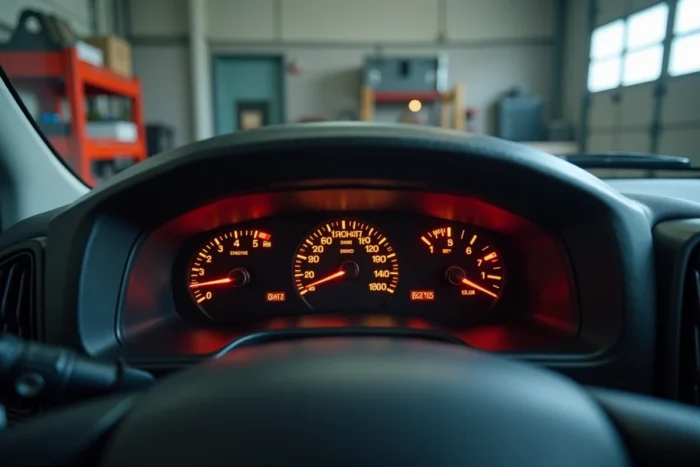
The coolant temperature warning light (red thermometer) requires an immediate stop. On Daily vehicles used intensively (dump trucks, loaded flatbeds), overheating often occurs after radiator clogging or thermostat failure. We observe that this light sometimes illuminates intermittently due to an aging temperature sensor, without actual overheating, hence the importance of a diagnostic tool check.
AdBlue and Particulate Filter Warning Lights on the Daily
The SCR system of the Daily uses an AdBlue tank whose level is monitored by an ultrasonic sensor. When the orange AdBlue light comes on, there are about a thousand kilometers of range left before entering degraded mode. With the red AdBlue light, the control unit limits speed and prevents restarting after the ignition is turned off.
The particulate filter (DPF) warning light deserves special attention:
- Steady orange: the filter requires regeneration. Driving at a stabilized speed on a highway for about twenty minutes is usually sufficient.
- Flashing orange: passive regeneration has failed multiple times. Forced regeneration via the diagnostic tool is necessary.
- Red: the filter is saturated. The vehicle enters severe degraded mode with torque limitation. Cleaning or replacing the DPF is required.
On fleets that make repeated short trips (urban delivery), the DPF clogs much faster. A scheduled regeneration cycle every week via Iveco telematics significantly reduces downtime.
Active Safety Warning Lights and New Regulatory Obligations
The ABS warning light (orange) and the ESP warning light (triangle with tire tracks) indicate a fault with the wheel sensors or the hydraulic unit. Deactivated ABS also removes emergency braking assistance, which notably increases stopping distances, especially when loaded.
The battery warning light (red) indicates a charging fault with the alternator. On the Daily, the accessory belt also drives the power steering pump: a break causes both a loss of charge and a loss of steering assistance.

As of July 1, 2024, new Iveco Daily vehicles sold in the European Union will include Intelligent Speed Assistance (ISA), which reads speed limit signs and GPS data to alert the driver in case of exceeding the limit. This system adds a dedicated warning light on the cluster.
Starting July 7, 2026, every new Daily registered in the EU must be equipped with the ADDW (Advanced Driver Distraction Warning) system. A camera focused on the driver monitors gaze and head orientation. A new distraction warning light will appear, accompanied by auditory or haptic alerts, when the driver looks away from the road for more than a few seconds. Regulation (EU) 2019/2144 mandates local and real-time processing, without permanent image recording by default.
These regulatory additions increase the number of pictograms on the Daily’s cluster. We recommend fleet managers update their driver training materials to incorporate these new warning lights before the delivery of the affected vehicles. An unknown warning light can cause either unnecessary panic or dangerous indifference, both reactions that can be corrected through knowledge of the dashboard.