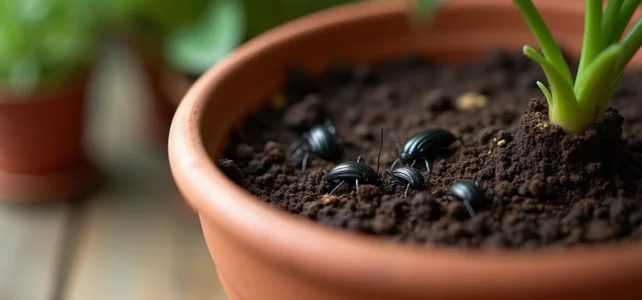
A tiny black dot jumps on the edge of your bathtub or on the kitchen tiles. The common reflex is to think of fleas, but in most cases, these small jumping black insects are springtails, organisms that indicate an excess of moisture much more than a strict parasitic infestation.
Springtails and humidity: the real diagnosis behind the little black bugs
Springtails measure between one and two millimeters. Their rounded or elongated body, often black or dark gray, makes them difficult to distinguish with the naked eye. What gives them away is their ability to jump thanks to a folded ventral appendage under the abdomen, called furca, which relaxes like a spring.
Their presence in a house is not a hygiene problem. Springtails do not bite, do not transmit any diseases, and do not damage structures. They feed on microscopic molds and decomposing organic matter. An overwatered indoor plant pot, a poorly ventilated bathroom, a moldy shower seal, or a leak under a sink is enough to create their ideal habitat.
Before looking for an insecticide, one should think about diagnosing humidity. To learn everything about jumping black insects and check if they are indeed springtails, observe precisely where you find them: window sill, flower pot, shower tray. If the critters concentrate in a damp area, the doubt is cleared.
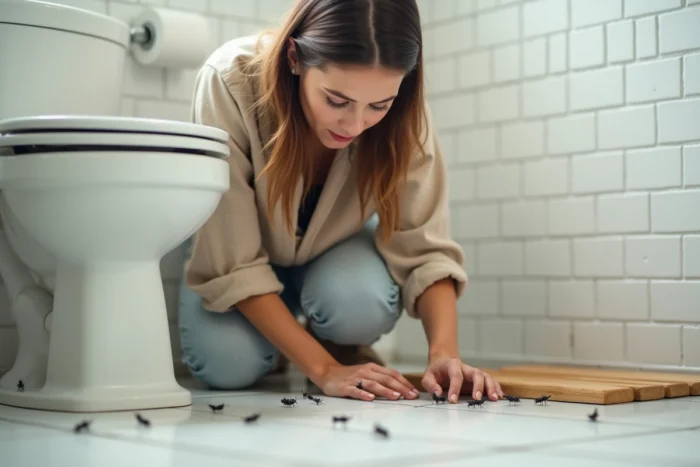
Fleas: how to distinguish them from a springtail
The confusion between fleas and springtails is common because both jump and both are tiny. The difference lies in a few simple criteria to check.
- Fleas are laterally flattened (thin body seen from the front), dark brown to black, and measure between one and three millimeters. They jump very high relative to their size.
- Springtails have a rounder or cylindrical body, jump less high, and never try to land on a living being.
- Fleas leave grouped bites on the ankles and calves, with a central red dot surrounded by a halo. Springtails do not bite at all.
- In the presence of a pet (dog, cat), the likelihood of fleas increases significantly. Without an animal, it drops.
A quick test involves placing a white plate filled with soapy water on the floor, under a lit lamp at night. Fleas, attracted by the heat, jump towards the light and drown in the water. If the plate remains empty by morning, the jumping insects are probably not fleas.
Other small black insects not to be confused
Two other categories of black insects regularly appear in homes without jumping.
Carpet beetles
Carpet beetles are small round, often spotted beetles that measure a few millimeters. Their larvae feed on textile fibers, wool, feathers, and dead skin. They are found in closets, under furniture, and along baseboards. They do not jump but crawl slowly. Their presence is mainly detected by damage to clothing and carpets.
Lost flea beetles
The flea beetle is a jumping garden beetle, sometimes called a soil flea. Black and shiny, it measures a few millimeters and jumps vigorously when disturbed. It may enter the house through an open window, especially in spring and summer. A flea beetle inside does not settle permanently: it seeks cruciferous leaves, not your kitchen. Escorting it outside is sufficient.
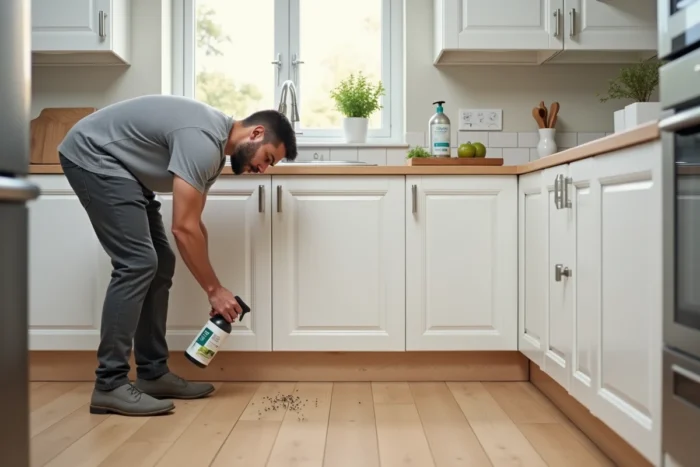
Getting rid of jumping black insects without chemicals
The treatment directly depends on the identification. Treating springtails like fleas means spraying an unnecessary insecticide without addressing the cause.
Against springtails: reduce humidity
Eliminating the source of humidity is sufficient in the vast majority of cases. Ventilate the bathroom after each shower. Reduce watering of indoor plants and replace waterlogged potting soil. Check shower seals, traps, and pipes for even minor leaks. Without humidity or mold, springtails disappear within a few days.
Against fleas: a two-step protocol
Treat the animal first with an appropriate anti-parasitic (spot-on, tablet) prescribed or recommended by a veterinarian. Then thoroughly vacuum all textile surfaces: carpets, rugs, cushions, floor cracks. Wash textiles at high temperature. Regular vacuuming for two to three weeks eliminates eggs and larvae that survive the first pass.
Against carpet beetles
Vacuum infested areas (closets, under furniture, baseboards). Wash or freeze affected textiles. Store wool and seasonal clothing in airtight covers.
When to call a pest control professional
Most situations can be resolved with the measures described above. A professional becomes useful in two specific cases: a recurring flea infestation despite treating the animal and habitat, or a population of springtails that returns after correcting all visible sources of humidity, which may indicate a structural problem (leak in a wall, rising damp).
The most cost-effective reflex remains observation. Note the exact location, the behavior of the insect (jumps or crawls, bites or not, attracted by light or water) and take a macro photo with a smartphone. This information allows any specialist to make a reliable diagnosis without even having to visit.