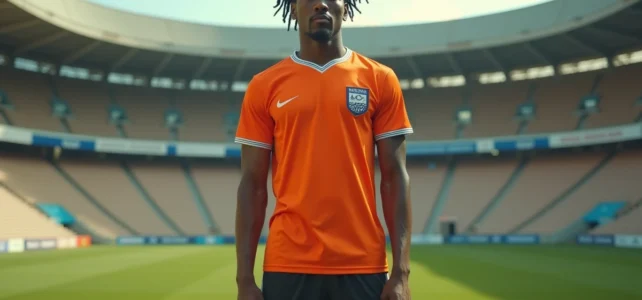
Ruud Gullit stood at 1.91 m, playing as an attacking midfielder, central defender, or forward depending on his team’s needs. Born on September 1, 1962, in Amsterdam, this Dutchman of Surinamese descent traversed European football in the 1980s and 1990s, blurring all tactical lines. His nickname, the “Black Tulip,” encapsulates the blend of technical elegance and physical power that made him so difficult to contain.
Gullit’s Tactical Versatility: An Unmatched Profile in Modern Football
Have you ever seen a player change positions three times in the same match without losing effectiveness? Gullit did it regularly. A natural attacking midfielder, he could drop back to central defense or push forward as a striker with equal ease.
This versatility was not just makeshift. It stemmed from a rare combination: above-average height, ball skills honed from childhood in the streets of Amsterdam, and a game vision inherited from the Dutch tradition initiated by Johan Cruyff. Gullit read the game like a sweeper and attacked like a center-forward.
Specifically, at AC Milan under the guidance of Arrigo Sacchi, he occupied a hybrid role. Sacchi asked him to drop back to build the play, then surge into the opponent’s box. This fluid positioning, without a fixed role, foreshadowed what football today calls a “false nine,” long before the term existed. One can consider Ruud Gullit as a football player to be one of the pioneers of this tactical approach in Europe.
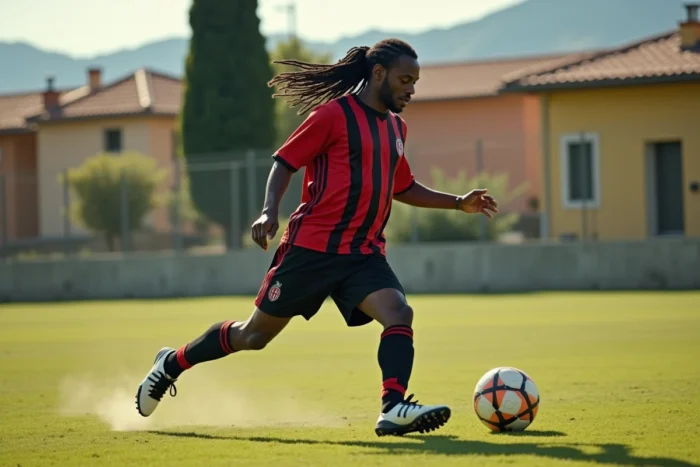
Dutch Trio at AC Milan: Gullit, Van Basten, and Rijkaard
The late 1980s AC Milan remains one of the most feared teams in the history of European football. At the heart of this project were three Dutchmen: Gullit, Marco Van Basten, and Frank Rijkaard. Their complementarity went beyond simple understanding on the pitch.
Rijkaard provided balance in midfield, recovering balls and launching plays cleanly. Van Basten finished with surgical precision. Gullit, in turn, linked the two. He created the spaces that Van Basten exploited.
This trio led Milan to win two consecutive European Cup titles. What stands out in archival footage is the fluidity of exchanges between these three players. They found each other almost instinctively, a result of years spent together in the Dutch national team even before their arrival in Milan.
A Recruitment That Changed Serie A
Gullit’s arrival at AC Milan in 1987 marked a turning point for the Italian league. The club bet on an atypical profile for the time: a complete player, not a specialist. The 1987 Ballon d’Or rewarded exactly this ability to do everything on the pitch.
This transfer opened the door for other Dutch recruits and helped make Serie A the most attractive league in the world for a decade.
Euro 1988 with the Netherlands: Captain Gullit’s Triumph
Euro 1988 in West Germany remains the only major title for the Netherlands national team. Gullit was its captain. In the final against the Soviet Union, he scored a header, typical of his style: a sharp run, impressive leap, perfect positioning.
This tournament revealed to the general public what followers of Dutch football already knew. The Netherlands had an exceptional generation, and Gullit was its natural leader. His charisma on the pitch, his recognizable dreadlocks, and the way he wore the captain’s armband with authority and ease all contributed to making him an icon.
- Captain and scorer in the Euro 1988 final against the USSR, a match where he physically and technically dominated the opposing defense
- Decisive partnership with Van Basten, whose goal in the final remains one of the most famous in football history
- Leadership of a group that also included Rijkaard, Ronald Koeman, and other players trained in the total football tradition inherited from Cruyff
This victory remains to this day the only major trophy for Dutch football, highlighting the significance of this generation.
Gullit’s Social Commitment and Legacy After His Playing Career
After hanging up his boots, Gullit did not disappear from the football landscape. He coached, notably Chelsea, where he was one of the first black coaches of a major English club. He also worked as a consultant and speaker.
A lesser-known aspect concerns his work with youth. Gullit advocates for “street football” as a training matrix, directly referencing his own journey in the streets of Amsterdam. He collaborates with initiatives using football as a tool for social integration, particularly for at-risk youth.
More recently, he has engaged in the debate about the future of Dutch football. He believes that the federation (KNVB) must modernize its structures while preserving the uniquely Dutch style of play. He has publicly discussed names for the national team coach position after recent disappointments in major competitions.
- Commitment to sports integration programs, emphasizing the importance of free play for youth
- Regularly taking a stand on Dutch training and the need to return to the fundamentals of “total football”
- Informal advisory role in discussions around the selection of Dutch national team coaches
Gullit has also denounced racism in football, a personal fight linked to his Surinamese roots. His journey transcends the sporting realm and touches on deep social issues that have plagued European football for decades.
Ruud Gullit’s legacy is not limited to a trophy cabinet. It lies in a way of conceiving football: fluid, without positional boundaries, driven by game intelligence rather than specialization. The versatile players dominating today’s football owe him, often unknowingly, part of their tactical freedom.