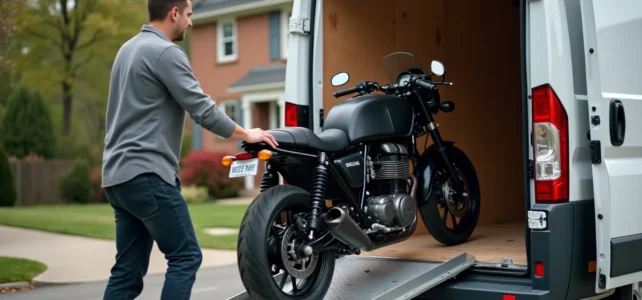
Transporting a motorcycle over several hundred kilometers for a track day, a private purchase, or a move presents a concrete problem: most motorcyclists do not own a trailer or a suitable vehicle. Renting a van solves this equation by providing a closed space, protected from the elements, with a sufficient payload capacity to accommodate the bike and its gear.
Securing in a rented van: what really matters during loading
People often think about the vehicle’s size first. The real issue is securing the bike. A poorly strapped motorcycle in a van can tip over at the first roundabout, damaging the interior, the bike, or both.
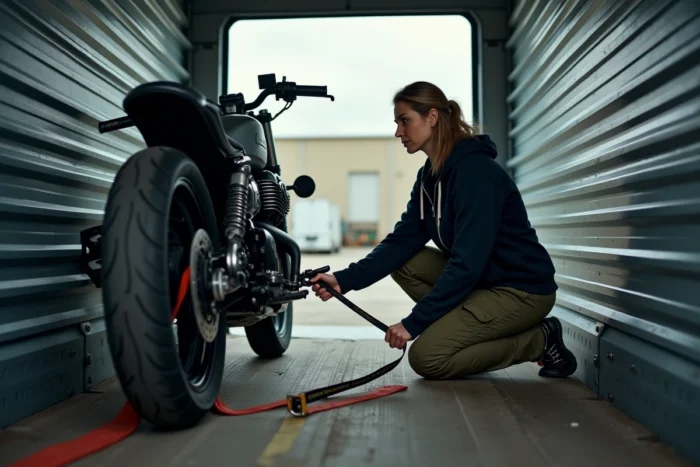
Before loading, check the anchoring rings on the floor. Since the reform of the vehicle technical inspection in May 2018, the fixation points, the floor, and the chassis structure are inspected more strictly on commercial vehicles. A recent rental van will normally have rings in good condition, but it’s worth confirming during pickup.
The reliable method: four crossed ratchet straps, two at the front and two at the back, which compress the motorcycle’s suspension downwards. The side stand remains deployed as a secondary support, not as a primary holding point. Position the front wheel against the wall or in a wheel gutter if the rental company provides one.
Choosing van rental for motorcycle transport allows access to a vehicle with a flat floor and rigid walls, significantly simplifying this step compared to an open trailer exposed to crosswinds.
Payload and van size: choosing the right dimensions
Not all motorcycles weigh the same, and not all vans offer the same payload. A lightweight sportbike and a touring bike loaded with luggage do not require the same vehicle.
Compact van or large volume
A van of type L1H1 (the smallest size at most rental companies) is sufficient for a standard motorcycle. The loading length generally exceeds two meters, which is suitable for most machines. The decisive criterion remains the height of the rear door: if the handlebars don’t fit, nothing goes in.
For an adventure bike with a top case or to load two motorcycles, you’ll need an L2H2 or L3H2 van. The additional payload accommodates the weight of the bikes, straps, tools, and possibly track equipment.
Loading ramp: to be provided by yourself
Most rental agencies do not provide a ramp. You’ll need to bring your own or rent one separately. A foldable aluminum ramp, wide enough for the rear tire, avoids the hassle of loading by brute strength. Improvised wooden planks should be avoided as they can be too slippery and potentially dangerous.
- Check the payload listed on the van’s registration document, not just on the rental company’s ad
- Measure the height of the handlebars, including mirrors, before reserving a vehicle
- Plan for padding (blanket, foam) between the motorcycle and the side walls to prevent friction
Condition report of the van: protecting your security deposit
Transporting a motorcycle in a rental van increases the risk of minor damages: strap scratches on the rings, tire marks on the floor, handlebar dents on the walls. These seemingly trivial details can be costly upon return.
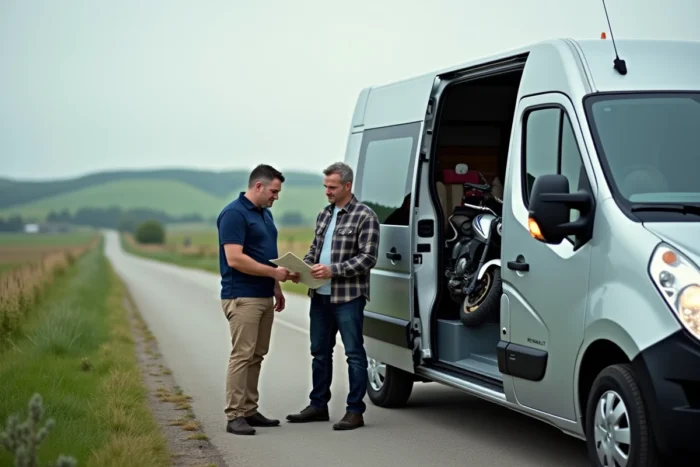
Photographing all four sides, the four corners, the floor, and the interior equipment at departure is the best protection. Since 2022, the ANCT has recommended this systematic checklist for rental vehicles, specifically to limit disputes upon return.
When loading, protect the floor with an old rug or a thick tarp. The contact points between the strap and the bodywork also deserve protection (foam sleeve, thick cloth). These precautions take five minutes and can save several hundred euros on the security deposit.
One-time rental or personal trailer: decide based on frequency
This question consistently arises in motorcycle forums: should you invest in a motorcycle trailer or rent a van each time you need it?
If you transport your motorcycle less than three or four times a year, renting is significantly more economical than buying a trailer. No storage fees, no maintenance, no trailer registration to manage. You pick up the vehicle in the morning, load it, drive, and return it in the evening.
The trailer has the advantage when you have back-to-back track days or regular trips. Feedback on this point varies based on usage: a motorcyclist who rides ten times a season quickly justifies the cost of a used trailer, while an occasional buyer picking up a motorcycle from the other end of the country only needs it once.
- Van rental: no storage, no maintenance, controlled cost for occasional use
- Motorcycle trailer: higher initial investment, but decreasing cost per trip with frequency
- Closed van: protection against rain and splashes, discretion of the load (no visible motorcycle from the outside)
One last often-overlooked point: the license. Driving a rental van only requires a standard B license as long as the GVW does not exceed 3.5 tons. With a loaded trailer, you can exceed this threshold and be required to have a BE license, complicating matters for some drivers.
The rented van remains the most straightforward solution for secure motorcycle transport without prior infrastructure. Properly preparing the securing, choosing the right size, and documenting the vehicle’s condition at departure are enough to turn the operation into a formality.